 Other contractors' emails · You pay per lead, not per send
Marketing that
only costs you
when it works.
Buying leads means paying up front and hoping. This flips it: your deal rides other contractors' monthly emails — out to their client lists, which can be bigger than yours — and you pay nothing until a homeowner actually claims it. And it cuts both ways: feature their deals in your email, and half of every claimed lead fee is yours.
You pay first.
You hope second.
Most lead-gen makes you pay before you know a thing about the job — and the same lead often lands in four other inboxes at the same time. It's a race to the phone, on your dime.
The platform decides what a lead costs — you pay their number, not yours, and many charge a membership fee on top just to be listed.
The same lead gets sold to a handful of contractors at once, so you're cold-calling a stranger who's already been called three times.
Your own email list is only so big. Reaching new homeowners means renting someone's ad platform — another monthly bill.
Set a bid.
Ride the network.
No ad account, no monthly minimum. Post one offer, decide what a lead is worth to you, and let it go out across every contractor featuring deals.
Post your deal and your per-lead fee
Write a simple seasonal offer and set your per-lead fee — anywhere from $15 to $1,000. That number is your bid: it's what you'll pay when a homeowner claims the deal, and it decides how many emails your offer rides in.
You set the bidYour deal goes out across the network
Every month your offer is featured in other contractors' emails — sent to their own client lists, not just yours. Higher bid, more emails. Several contractors featuring your deal means many lists combined.
Many lists, one dealA homeowner claims it — you pay only then
When someone on one of those lists claims your deal, it lands as a warm lead with their contact info. You pay your posted fee plus a flat 10% platform fee — and only when a lead actually comes in. Never per email sent.
Performance-fundedOne offer, out across the network.
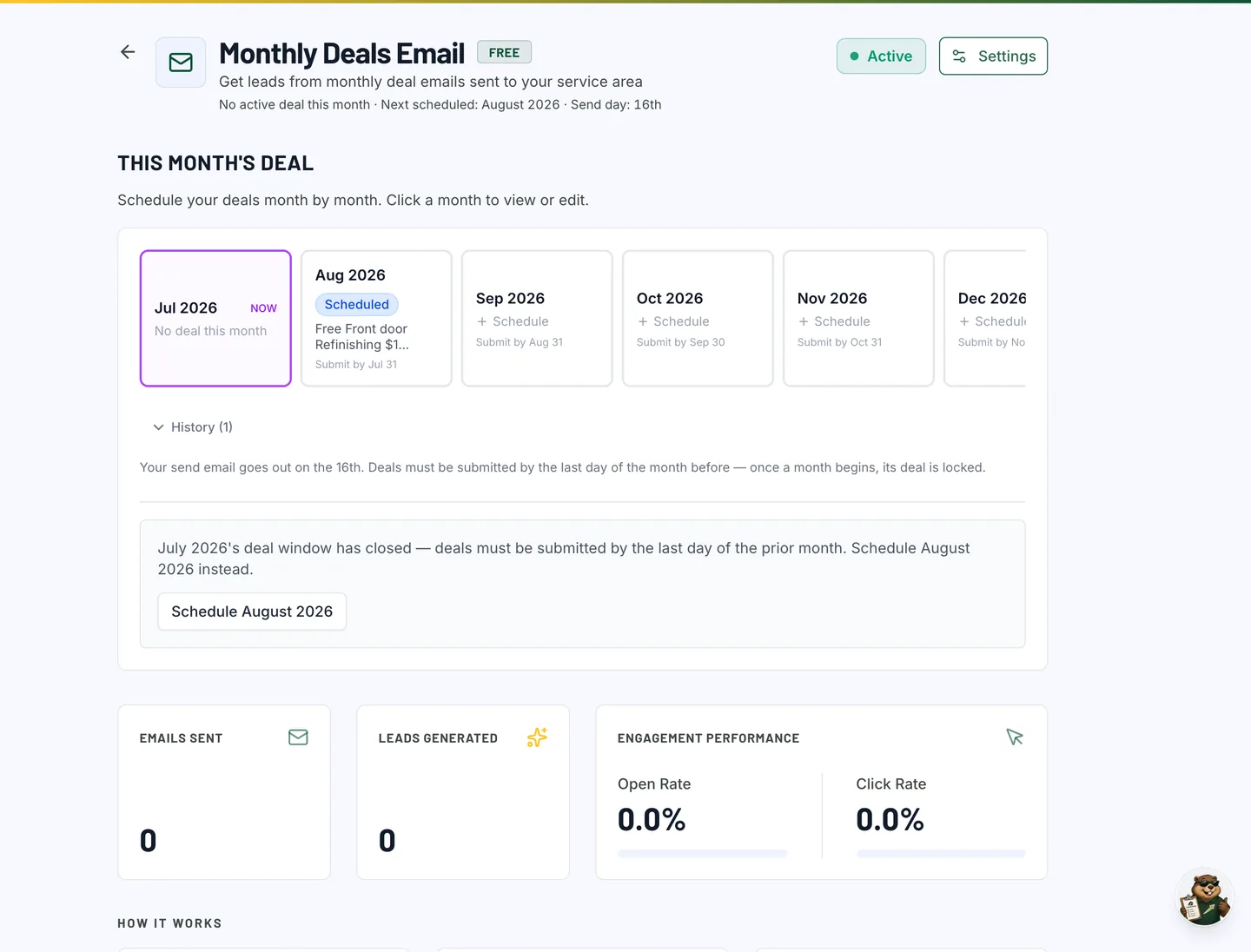
Here's the deals screen inside LeadChuck — your offer, your per-lead bid, and where it's running. This is the real product, not a mockup.
Where your money actually goes
No up-front spend, no per-email charge. The math is simple:
- To joinFree
- Per email sent$0
- When a homeowner claimsYour fee + 10%
- When your email sends a claim the other wayYou earn 50%
Your client list is worth money.
Get paid to send.
Deals go both ways. Feature other contractors' offers in your monthly deals email, and every time one of your clients claims one, 50% of that contractor's posted lead fee lands in your balance — cash, not credit.
Half the posted lead fee on every claim your email produces. A contractor posted a $100-per-lead deal and your client claims it? $50 is yours — withdrawable cash once the lead clears its hold.
Matching is automatic. Deals are picked for each client's city, from contractors above the network's trust bar — you don't curate a thing.
Competing trades are filtered out of your email — every trade you work in, by default. Your clients only ever see offers you don't sell yourself.
Questions, answered.
It's a way to get in front of homeowners without buying leads. You post a seasonal offer, and it gets featured in other contractors' monthly emails — going out to their client lists, which can be bigger than your own. When a homeowner claims your deal, it comes to you as a warm lead. And it works in both directions: feature other contractors' deals in your own monthly email and you earn half their posted lead fee on every claim.
The program itself is free to join — there's no monthly fee to feature a deal. You only pay when a homeowner actually claims it: your posted per-lead fee plus a flat 10% platform fee. Nothing is charged per email sent.
Your per-lead fee is your bid. Set it higher and your deal rides in more contractors' emails, so more homeowners see it; set it lower and it goes out in fewer. You choose the number based on how many leads you actually want and what a lead is worth to you.
No. Your weekly lead budget caps the everyday referral leads you accept, but deal-email leads are the exception. Once your offer is out in this month's emails, those leads keep arriving as homeowners respond — there's no way to un-send an email. You control deal volume with your bid instead.
Half that contractor's posted per-lead fee, in cash. If they posted a $100-per-lead deal and one of your clients claims it, $50 goes to your balance — pending while the lead clears its standard hold, then yours to withdraw. The deals featured in your email are matched to each client's city automatically and never overlap your own trades by default.
You can set it anywhere from $15 to $1,000. A good rule of thumb is to set it low enough that a lead that doesn't pan out never stings — the cost-per-lead calculator on the compare page helps you find a ceiling. The number is entirely your call.
Deals are one tool in the kit.
LeadChuck is a contractor-to-contractor network. Once homeowners are finding you, here's where the rest of the growth comes from.
Turn clients into referrers
Give a past client a link to pass to a friend and thank them with a gift card when they do. See how the referral program works.
Referral gift cards →Email your own list
Send a polished email to your own clients in under a minute — type a few notes, and Chuck writes the draft for you.
Email blast →Get paid to refer
No trade license? Become a Scout and earn a cut every time an introduction you make gets accepted.
Become a Scout →Run a month's numbers.
Say your deal rides 300,000 emails across the network this month and 20 homeowners claim it. Meanwhile your own monthly email is featuring other contractors' deals. Here's the whole picture.
- Your deal: 20 claimed leads at your $80 bid−$1,600
- Flat 10% platform fee on those leads−$160
- Your email: 18 claims on others' deals (avg $100 fee — half is yours)+$900
- Net spend for 20 exclusive, warm leads$860 — $43 a lead
And every one of those 20 came to you alone, off an offer the homeowner chose — not a shared lead four contractors are racing to call. Warm one-to-one leads close at a better rate, which is what really drives your cost per job down.
Reach more homeowners. Pay only when it works.
Post a deal, set your bid, and let it ride the whole network — then get paid when your own email returns the favor.
Get Started →Free to join · Pay per claimed lead · Cancel anytime